How to Automate Outbound Sales in 2026 (Without Losing the Human Part)
Outbound automation fails when teams automate tools but not decisions. Here's the framework that actually works—and the parts you shouldn't automate.
Most outbound automation projects start backwards.
Teams buy a sequencing tool, import a list, turn on a drip, and wait. The reply rates are low. The conclusion is that automation doesn't work, or that outbound doesn't work for their market. The actual problem is that they automated the sending but not the thinking behind it.
Automation is a force multiplier. It multiplies whatever you put in. If you put in a generic list and a generic message, automation multiplies your reach and scales your genericness. The volume gets higher; the results stay low.
What you're actually automating
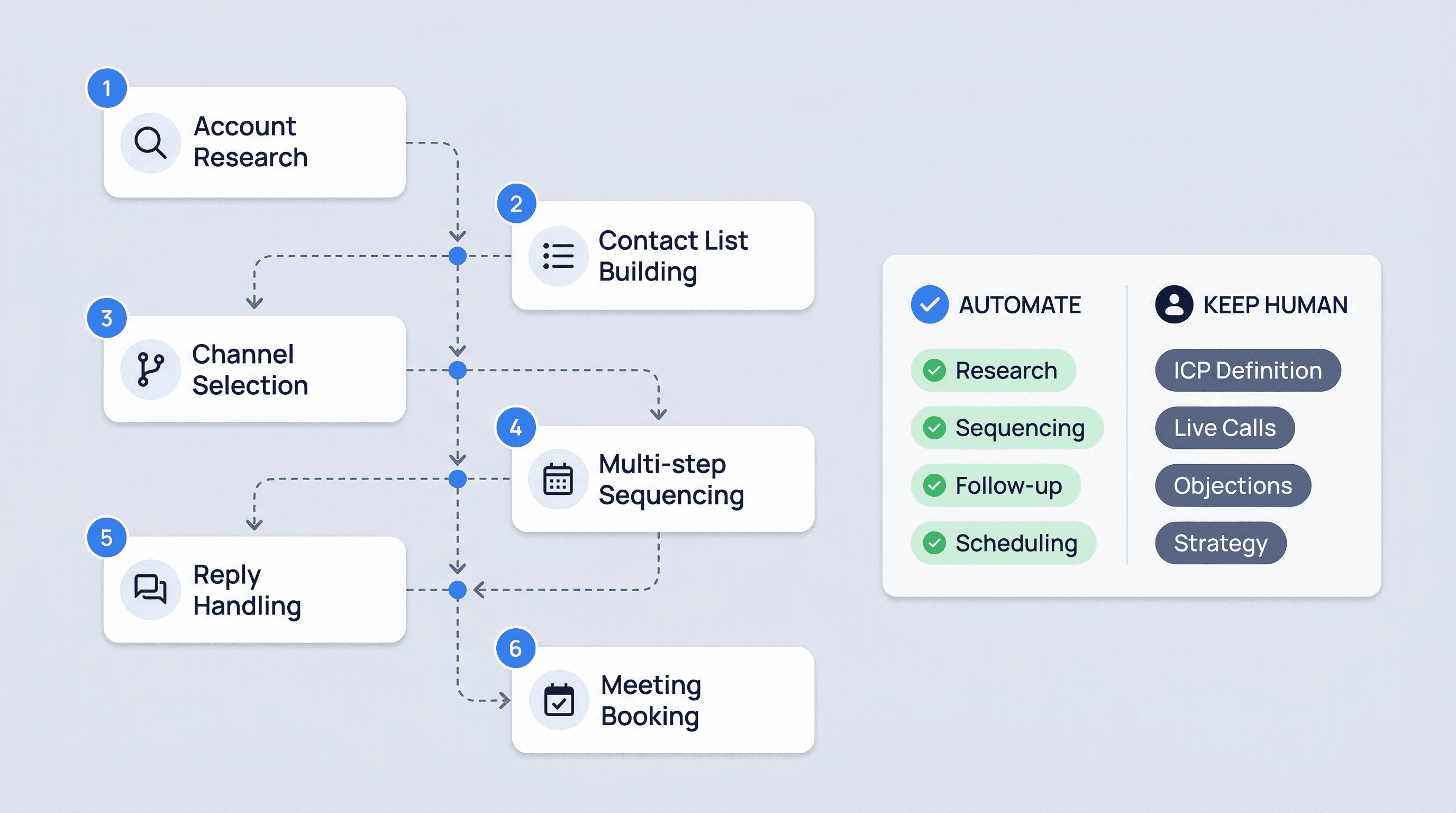
Outbound has two layers: decisions and execution. Automation is for execution. Decisions stay human.
Execution work (automate this):
- Account research and qualification
- Building and refreshing contact lists
- Sequencing and scheduling outreach
- Follow-up across channels
- Meeting scheduling and calendar management
- CRM updates
Decision work (don't automate this):
- ICP definition and account scoring
- Messaging strategy and positioning
- Live discovery conversations
- Objection responses that require judgment
- Whether a warm signal is real or polite noise
The teams that over-automate blur this line. They use AI to generate the ICP ("we'll sell to anyone who might need us"), AI to score accounts ("high intent score = good enough"), and AI to write copy ("generate a personalized message") without anyone checking whether the output actually makes sense for the context.
Then they're surprised when 10,000 automated emails produce three qualified meetings.
Build the automation sequence in order
The order matters because each step feeds the next. If you skip research, your personalization is fake. If you skip personalization, your reply rates are too low to matter.
Step 1: Account research. Before any message goes out, know who you're reaching out to and why. The best automated research goes beyond data enrichment—it surfaces actual context: recent hires, funding events, product launches, hiring spikes. These are the signals that make a message feel specific.
Step 2: Contact list building. Identify the right decision-maker for your ICP at each target account. Not "anyone with a relevant title"—the specific person whose problems you solve. Automated list building runs continuously as new accounts enter your target market.
Step 3: Channel selection. Different roles and regions respond to different channels. Automated channel selection means not defaulting to email for everyone, but routing each contact to the channel most likely to work.
Step 4: Sequencing. Run a multi-step, multi-channel sequence. Start on email, add LinkedIn, escalate to WhatsApp where appropriate. The sequence runs on a consistent schedule, not when someone remembers to follow up.
Step 5: Reply handling. When a prospect replies, the response needs context—what was said before, who the person is, what stage of the conversation this is. Automated reply handling reads that context and responds appropriately, escalating to a human when the signal is genuinely warm.
Step 6: Meeting handoff. When a conversation reaches booking intent, the meeting gets proposed, confirmed, and added to the calendar—with full context prepared for whoever's taking the call.
The metrics that tell you if it's working
Not every metric matters at the same time. Early-stage automation should track:
- Reply rate: Are messages landing and getting responses? Below 3% signals a deliverability or messaging problem. 5–8% is solid at scale.
- Positive intent rate: Of replies, how many show genuine interest vs. unsubscribes and brush-offs? This is the real health metric.
- Meetings booked: Direct output. One qualified meeting per 100 contacts reached is a reasonable benchmark for early campaigns.
- Meetings held: Booked vs. held is a quality signal. If 40% of meetings are no-shows, the qualification step isn't working.
Track weekly, not monthly. Outbound has short feedback cycles if you're watching the right signals.
The domain warmup tax
One practical detail most guides skip: if you're running email outreach at volume, you need warmed sending domains. A fresh domain at full send volume is the fastest way to land in spam and ruin the campaign before it starts.
Warming a domain takes two to four weeks. Build this into the timeline before expecting results.
What sustainable looks like
Sustainable outbound automation means the pipeline runs on a schedule that doesn't require someone's daily attention to maintain. New accounts get researched. Sequences run. Follow-ups go out. Warm replies get handled. Meetings land in the calendar with context attached.
The humans on your team spend their time on calls, positioning, and strategy—not on remembering to send the third follow-up email to the account that went quiet on Tuesday.
See founder-led sales solution and follow-up automation. Also review AI SDR tools.