Best Prompts for a Sales Letter (With Examples That Actually Convert)
Prompts that produce specific, buyer-focused sales letters—not generic copy. Includes the framework, role variants, and the editing pass that makes AI output usable.
A sales letter makes a case. That's the whole job.
It's not an ad (no room for vague branding). It's not a brochure (no one reads those). It's an argument written for a specific person in a specific situation, making the case that your offer is the right move for them right now.
AI can write that argument well—if you give it the building blocks. Without them, it writes a generic argument for a generic buyer, which is persuasive to nobody.
Here's how to build the brief that makes AI output actually usable.
What the prompt must include
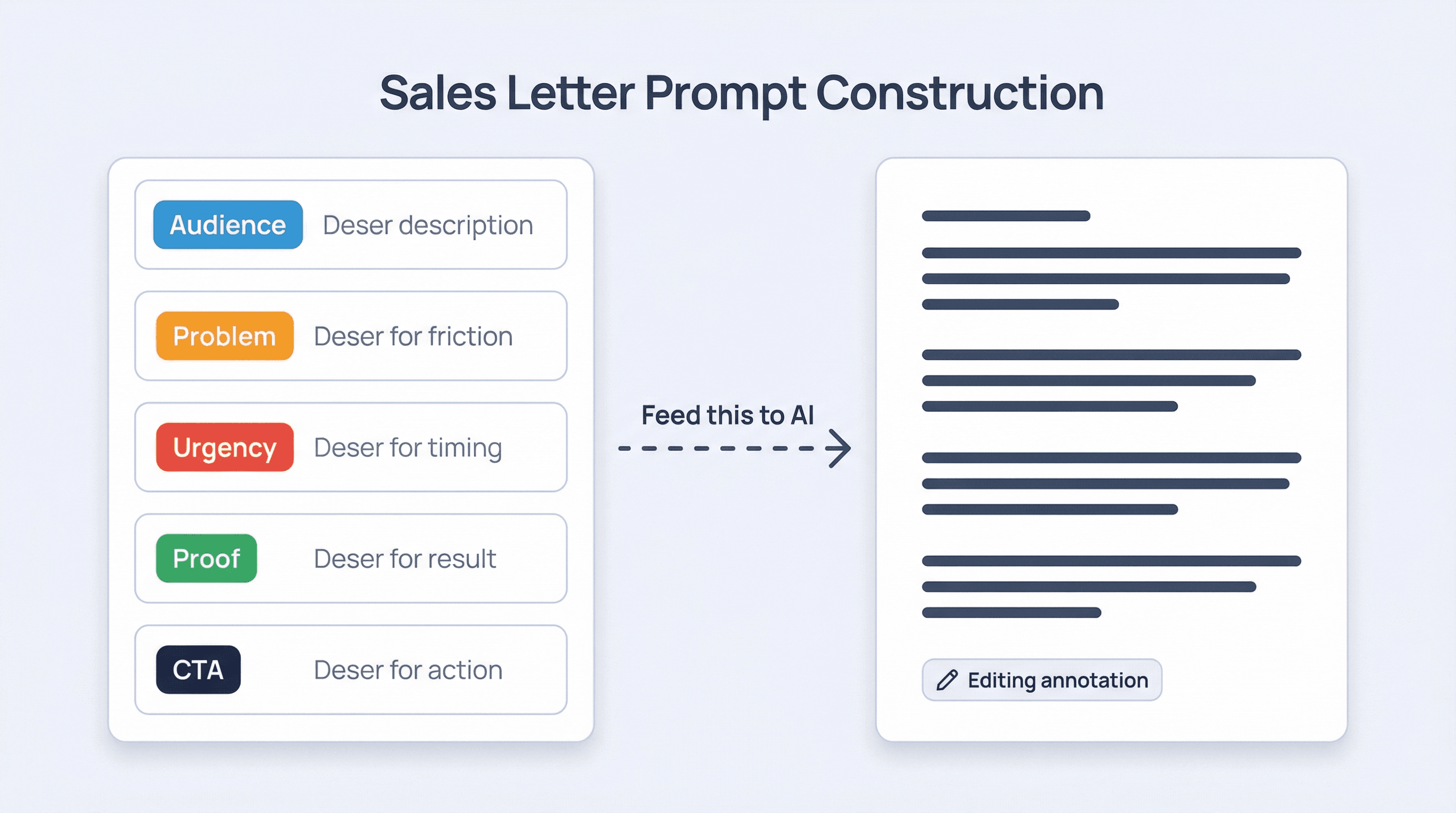
Audience specificity. "B2B buyers" tells the model nothing. "Founder of a 10–25-person marketing agency who grew on referrals and is now trying to build outbound without hiring an SDR" tells it something it can write to.
The problem and why it's urgent. Not "they struggle with outreach." The specific friction: "They're sending outreach manually, losing follow-up threads, and watching competitors who use automation pull ahead on pipeline volume."
The offer in one sentence. If you can't summarize it in one sentence, the AI will paraphrase your confusion. If you can, it will expand on clarity.
One proof point. One real, specific result. "Helped an agency get 4 qualified meetings per week without a full-time SDR" beats "proven results." Specificity signals credibility.
One CTA. Every additional option you give the reader is a reason not to take any of them. One ask.
The base prompt
Write a sales letter for the following:

Audience: [describe in 2–3 sentences—role, company size, specific situation]

Problem: [the exact friction they're experiencing, not a category]
Urgency: [why this is a problem now, not later]

Offer: [one sentence]
Proof: [one specific result or example]

CTA: [single action, clearly stated]

Tone: Direct. No marketing language. Write like you're explaining this to someone smart who's skeptical.
Length: [short version: 300–400 words. Long version: 600–800 words.]

Do not use these words: transform, leverage, unlock, empower, seamless, robust, dynamic, innovative.
Do not open with a question. Open with a direct statement about their situation.
Short version example (300 words)
For a 15-person agency founder:
Running outreach manually stops working the moment you have more than 20 accounts to cover.
Most agency founders hit this wall around the same time: referrals are still coming in, but not fast enough. The pipeline is inconsistent. You're doing the outreach yourself because nobody else owns it, and you're spending four hours a week on tasks that could run automatically.
The math is simple. If your average deal is $5,000/month and you could add two more qualified calls per week, that's $10,000 in potential new MRR per week of pipeline. The gap between where you are and where you want to be isn't effort—it's process.
We work with agencies like yours to build an outbound motion that runs on a consistent schedule: account research, multi-channel outreach, follow-up until qualified outcome. Most teams see their first qualified meetings in week two.
If you want to see what this looks like for your pipeline, reply to this email and we'll set up a short conversation.
That letter works because it describes a specific person, their specific friction, and makes a case with one concrete claim. The AI can produce this if you give it that level of specificity in the brief.
Role variants to customize per audience
Each role in the buying group needs a different version:
For the founder: Lead with time and pipeline predictability. They care about whether it runs without them.
For the head of sales: Lead with team leverage. They care about what their reps can accomplish when they're not doing manual work.
For the CFO: Lead with cost-per-meeting. They want the math. One comparison to the cost of an SDR hire makes the case.
The editing pass (run this after every draft)
Here is a sales letter draft.
Remove any sentence that could apply to a different company without changing a word.
Replace any vague claim with the specific proof point provided.
Cut any sentence that doesn't move the reader closer to the CTA.
Flag any banned words: transform, leverage, unlock, empower, seamless, robust.
Output the revised letter and list what you changed.
This editing prompt is often more useful than the writing prompt. The first draft gives you structure; the editing pass makes it specific.
See how this fits with account research for personalization, and reply handling for what happens when the letter works.