ChatGPT Prompts for Sales: 30 Templates by Stage
Sales prompts organized by prospecting, follow-up, objection handling, and meeting conversion—with context on why each one works.
The problem with most sales prompt libraries is that they're template lists. Copy, paste, send. No thinking required.
That's also why most AI-generated sales copy reads the same way across every sender in the inbox.
These prompts are different in one way: each one includes the context you need to feed before the prompt works. Because the context is where most people skip the work.
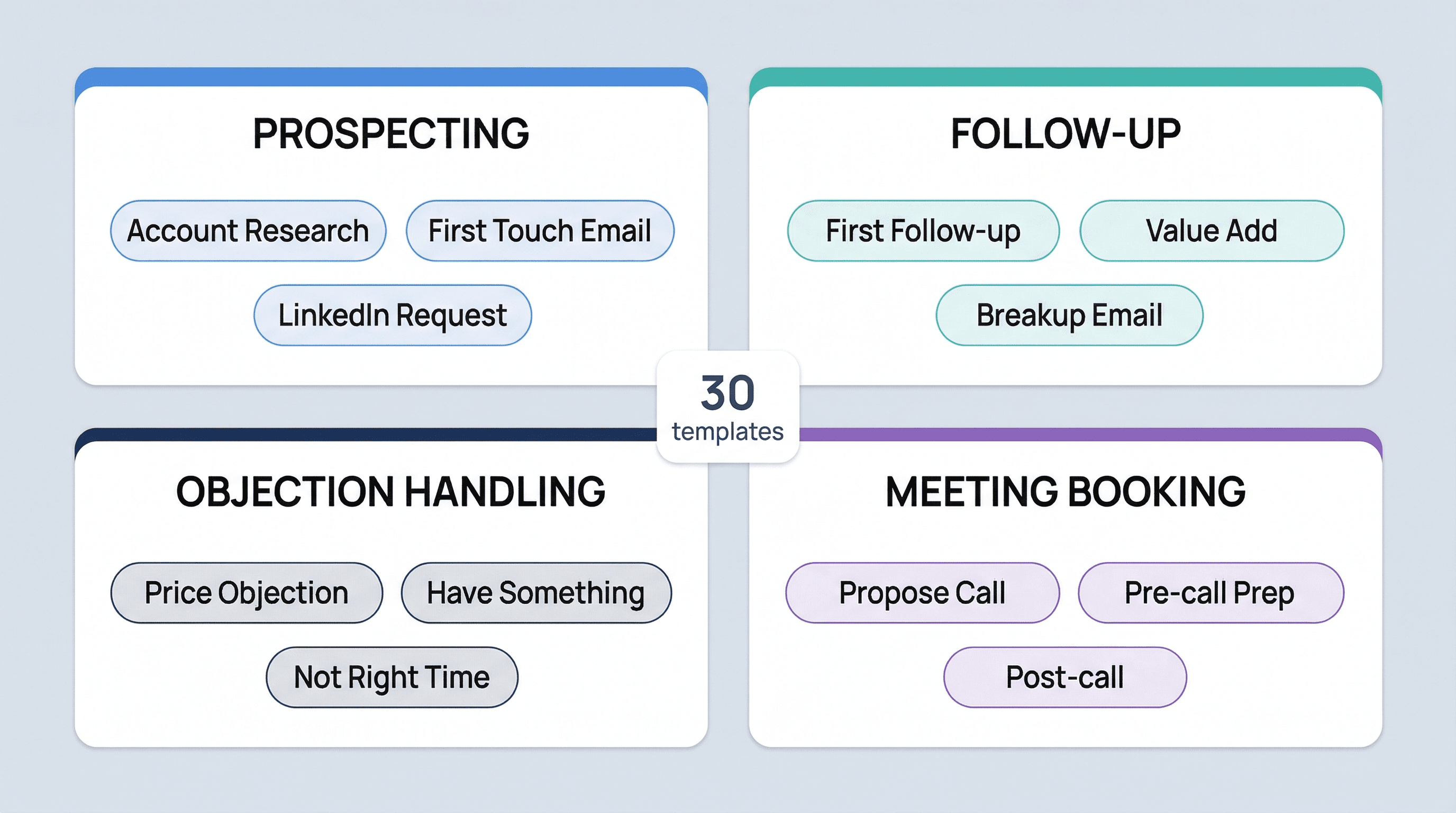
Prospecting prompts
Account research summary
I'm about to reach out to [company name]. They are a [describe company type and size].
Recent signals I found: [list 2–3 things—job postings, funding, news, product changes].
My offer: [one sentence].
Generate a summary of why this account is a good fit and the most specific angle I should use in my outreach.
First touch email
I'm reaching out to [role] at [company type].
Context: [specific trigger—recent hire, funding, expansion].
Our offer: [one clear sentence].
Proof: [one specific result].
CTA: [one action, low friction].
Write a cold email under 80 words. Open with the trigger, not with "I". No fluff.
LinkedIn connection request note
I want to connect with a [role] at a company that [specific situation].
I reached out by email last week about [specific topic].
Write a LinkedIn connection request note under 300 characters that's honest about why I'm reaching out.
No fake flattery. No generic "I'd love to connect."
LinkedIn follow-up after acceptance
Someone accepted my LinkedIn connection. They are a [role] at a [company type].
I previously emailed them about [specific thing].
Write a LinkedIn message that references the prior email, adds one new point of value, and asks one specific question.
Under 100 words.
Account-specific LinkedIn post comment
I want to engage genuinely with a prospect on LinkedIn.
Their post was about: [brief description].
My area of expertise: [your domain].
Write a comment that's substantive, adds a perspective, and doesn't try to sell anything.
Under 80 words.
Follow-up prompts
First follow-up after no reply
Context: I sent an initial email 5 days ago to [role] at [company type] about [offer].
No reply yet.
Write a follow-up that references the prior email, adds one new angle or data point, and keeps the same ask.
Don't open with "Just following up." Under 60 words.
Adding value in follow-up
I'm following up with someone who hasn't replied in 10 days.
Instead of repeating the pitch, write a message that gives them one useful piece of information—a stat, a question to consider, or a relevant observation—and ends with a soft CTA.
Role: [role]. Company: [company type]. Topic: [what you're offering].
Final follow-up (breakup email)
This is my last attempt to reach a prospect who hasn't replied after [N] touches.
Don't be aggressive or passive-aggressive. Give them a reason to stay in touch.
Leave the door open without groveling.
Under 50 words. No subject line suggestions.
Re-engagement after a long gap
I spoke with this person [X months] ago. They showed interest but the timing wasn't right.
Their role: [role]. Topic we discussed: [brief description].
Write a re-engagement email that references what was discussed, notes something that's changed or new, and proposes a low-stakes next step.
Objection handling prompts
Price objection
A prospect said: "[exact objection, e.g., 'your pricing is too high for us right now']"
Their role: [role]. Company size: [size]. Deal stage: [stage].
Write three different responses—one ROI-focused, one alternative structure, one that acknowledges budget reality and keeps the door open.
Don't be defensive. Don't immediately discount.
"We already have something" objection
Prospect said: "We're already using [competitor or internal solution]."
My key advantage over that solution: [specific differentiator].
Write a response that acknowledges their current setup, asks one qualifying question about their experience with it, and plants one seed about the specific gap we solve.
Under 100 words.
"Not the right time" objection
Prospect said timing isn't right. They're in the middle of [initiative they mentioned].
Write a response that validates their timing concern, notes the cost of delayed action (briefly), and offers two options: pause with a specific follow-up date, or a shorter-scope pilot.
Non-pushy tone. One ask only.
"Send me more info" non-commitment
A prospect asked me to "send more info" after an email exchange.
This often means they're not ready to commit to a call.
Write a response that sends one piece of value, doesn't overwhelm, and closes with a specific question—not just "let me know if you have questions."
Meeting prompts
Proposing a first call
I want to book a call with a prospect who showed mild interest.
Propose two specific time options. Anchor the meeting to a concrete outcome for them—not just "to learn more."
Keep it under 50 words. Don't use "quick call" or "hop on a call."
Pre-call prep email
I have a call scheduled in 3 days with [role] at [company].
We'll be discussing: [topic].
Write a short pre-call email that confirms the time, sets one agenda item, and leaves space for them to add their own priority.
Friendly but businesslike. Under 80 words.
Post-call follow-up
We just finished a call with [role] at [company].
Key things they said: [2–3 notes].
Next step agreed: [what you committed to].
Write a follow-up email that summarizes what was discussed, confirms the next step with a specific date or action, and closes warmly.
No-show follow-up
A prospect missed our scheduled call with no notice.
Write a response that's understanding, doesn't shame them, proposes to reschedule, and keeps the tone warm.
One try—if they don't reschedule, we pause outreach.
Under 60 words.
Run these at scale
These prompts work for individual messages. For outbound at volume—where you're running research, generating role-specific messages, and managing follow-up across 50+ accounts—the workflow needs to run automatically, not prompt by prompt.
See reply handling and meeting booking for how this works in practice. For vendor options, review best AI SDR tools.