AI Prompts for Outreach Emails: The Framework That Actually Personalizes
Most AI outreach prompts produce generic copy. This is a different approach—built on context, role, and trigger—that creates messages that sound like they were actually written for the recipient.
There are two ways to use AI for outreach.
The first is to ask it to "write a cold email for a marketing agency targeting SaaS companies." What you get is a competent, generic email that sounds like every other AI-generated cold email in someone's inbox. Open rate: fine. Reply rate: poor.
The second is to treat the AI as a writing partner that knows how to structure arguments but needs you to supply the substance. You give it the buyer's actual situation, the specific trigger, the one pain point you're addressing, and the one thing you want them to do. Then it turns that into something that reads like it was written for this person.
The output is entirely different. Not because the model is different—because the input is.
The context that makes the difference
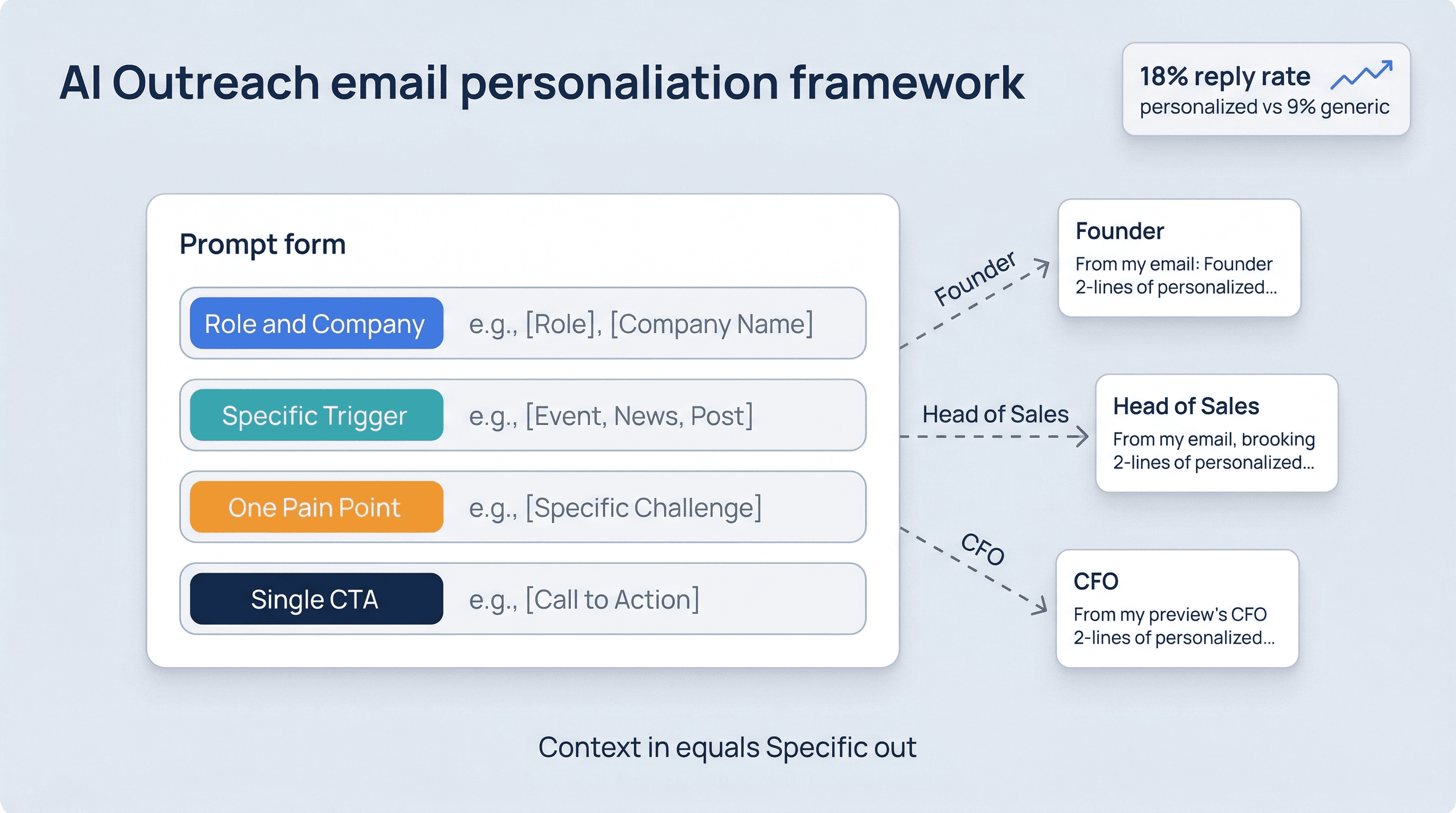
Before writing any outreach prompt, you need four things:
1. A specific role and context. Not "a marketer." A Head of Growth at a 25-person SaaS company that raised a Series A six months ago and is now building their outbound motion for the first time.
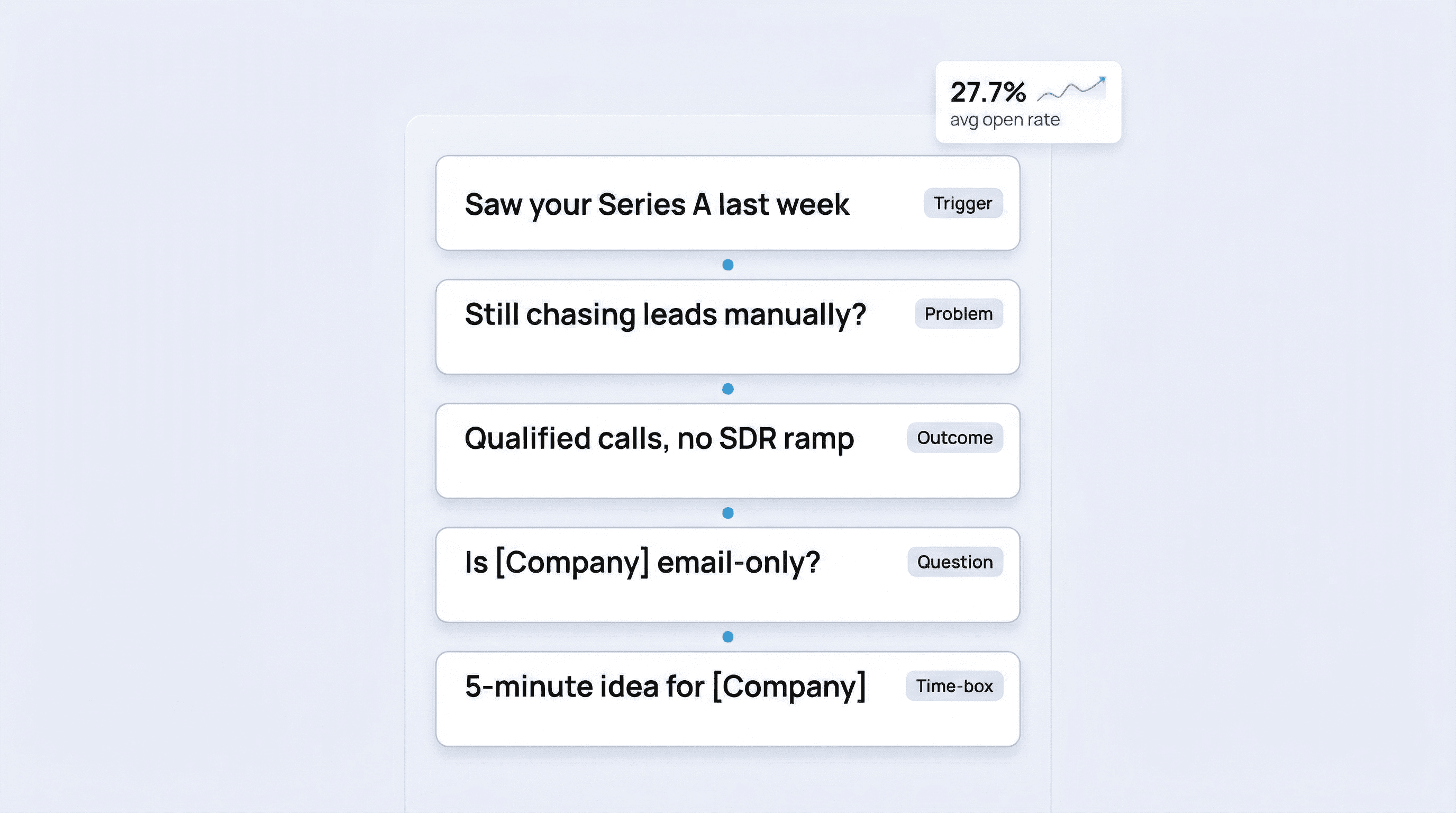
2. A specific trigger. Why now, for this company, today? They posted three SDR jobs last week. They published a case study about scaling their team. Their founder just spoke at a conference about sales process. Any of these gives the message a specific reason to exist.
3. The one pain. Not a category of pains—one. For the company in step 1: they're building outbound for the first time and don't know if they should hire SDRs or automate. That's the tension. That's what the message should speak to.
4. One ask. Not "reply if you're interested or book a call whenever works." One thing. A question, a confirmation, a reaction to a specific idea.
The prompt framework
Once you have those four things, the prompt looks like this:
I'm writing a cold email to [specific role] at [company type].

Trigger: [real, specific context—recent event, company signal]

Their likely situation: [2–3 sentences about what they're dealing with]

My offer: [one sentence, concrete]

One proof point I can include: [specific result, not a category]

CTA: [single action, framed as low-friction]

Write the email in under 80 words. Open with the trigger—not with "I wanted to reach out." No bullet points. No generic closers. Conversational tone.
Role-specific angles
Different roles have different filters. The prompt needs to match what the person cares about, not just who they are.
Founder / CEO: Focus on time and opportunity cost. They care about pipeline predictability and whether they have to do the selling themselves. Angle: "Here's what it costs to not have this running."
Head of Sales: Focus on pipeline consistency and team leverage. They care about numbers, ramp time, and quota attainment. Angle: "Here's what your team could cover if they weren't doing this manually."
CFO / Finance: Focus on unit economics and cost comparisons. They make budget decisions based on cost-per-meeting, not features. Angle: "Here's the math on what this costs vs. what you're spending."
Head of Marketing: Focus on lead quality and revenue contribution. They care about attribution and whether outbound is producing meetings that actually close. Angle: "Here's how other marketing teams are thinking about outbound ROI."
The follow-up prompt
Follow-ups are where most sequences lose the thread. The second message doesn't reference the first, adds nothing new, and opens with "Just following up on my email below."
A better follow-up prompt:
I sent a cold email 5 days ago to [role] at [company].

Original subject: [subject]
Original message: [paste it]

They haven't replied.

Write a follow-up that:
- References the prior message without restating it
- Adds one new piece of information or a relevant question they didn't have before
- Keeps the same CTA
- Doesn't open with "following up" or "circling back"

Under 60 words.
The objection-anticipation prompt
One technique most people skip: ask the AI to generate two or three likely objections from the buyer, then draft responses. Do this before the outreach goes out, not after someone replies with an objection you weren't prepared for.
Based on this outreach message: [paste message]
And this prospect profile: [role, company type, context]

Generate the two most likely objections this person would have.
For each objection, write a response that addresses it directly—without defensiveness, without immediately pivoting to a demo request.
This exercise often reveals gaps in the original message. If the most likely objection is "we already have something for that," and your message doesn't address that, the message isn't ready.
Where AI makes outreach worse
AI scales whatever you put into it. If the context is thin, the output is thin at scale. A loop that generates 200 "personalized" emails from a prompt that has no real personalization input produces 200 identical-feeling emails with different names in the first line.
The tell: if you can read the message and not know which company it was written for, it wasn't personalized. The AI gave you the structure. You forgot to give it the content.
See how context-rich outreach combines with account research for personalization at scale, and reply handling for what happens after the message lands.