Buying Group Selling: Why Your Single-Contact Strategy Is Failing
B2B buying committees now average 8–13 stakeholders. Here's how that changes outreach, deal management, and why single-threaded deals keep slipping.
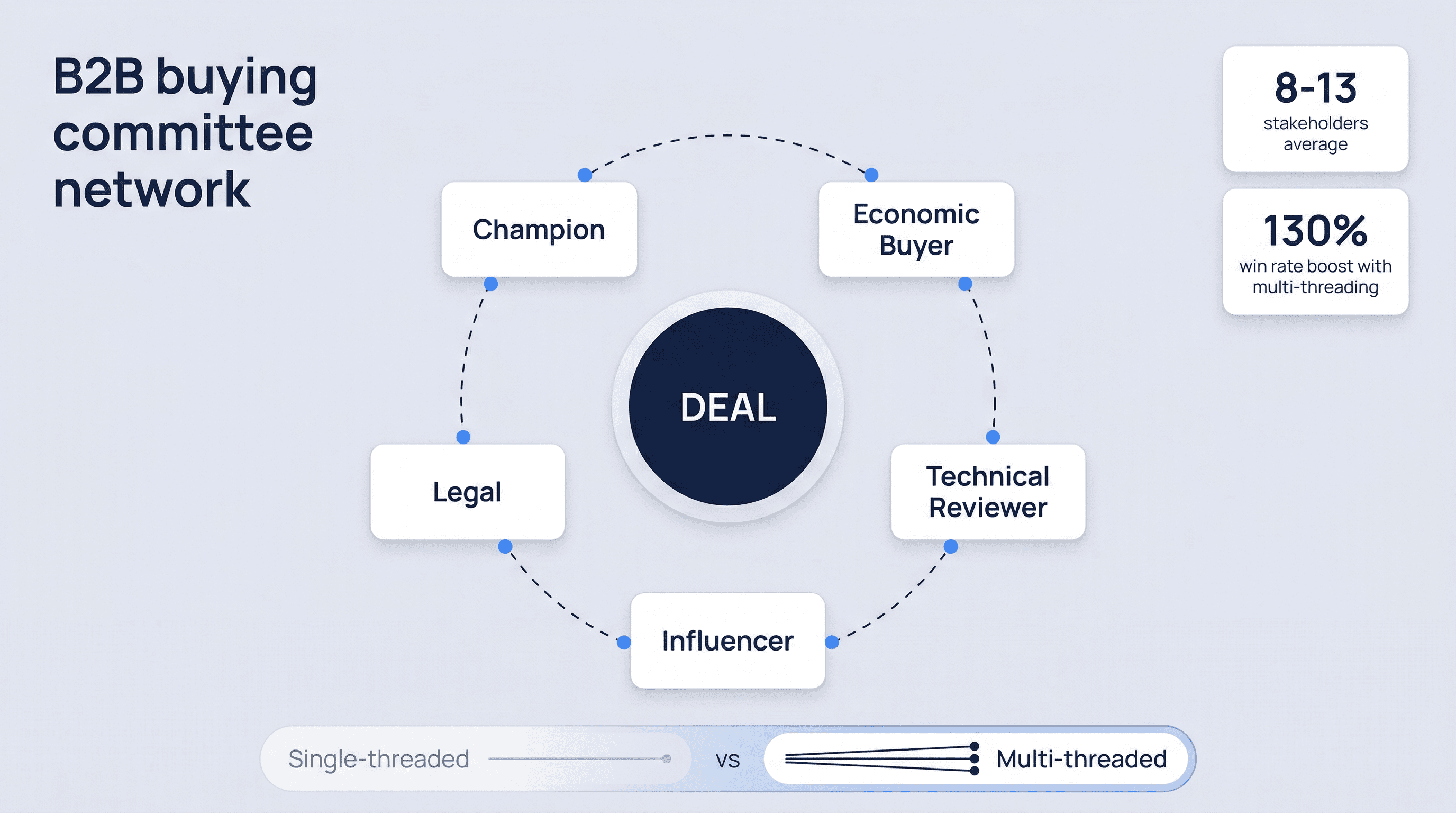
In 2015, the average B2B deal involved 5.4 decision-makers. By 2017 that number was 6.8. Today, Gartner puts it at 8–11 per deal, and Forrester says the average B2B purchase now involves 13 stakeholders across multiple departments.
That's nearly a 100% increase in a decade.
If your outreach motion is still built around one contact per account, you're not running a sales strategy—you're making a bet that your champion stays employed, stays engaged, and can navigate internal politics you'll never see. Sometimes that bet pays off. Often it doesn't.
Why deals die and it's rarely what you think
Single-threaded deals look fine until they don't. The champion who was your internal advocate gets reassigned. The CFO you never spoke to decides the budget isn't available this quarter. The technical reviewer nobody knew about surfaces a concern in the final week.
These aren't rare edge cases. They're how enterprise deals work when you only know one person in the room.
The data is pretty blunt here. Closed-won deals have approximately 2x more buyer contacts than closed-lost deals (Ebsta x Pavilion, 2025). Multi-threading boosts win rates by 130% for deals over $50K. And 78% of accounts are still single-threaded—meaning most of your competitors haven't figured this out either.
If your champion leaves mid-cycle, the deal close rate drops 56%.
What the buying committee actually looks like
Different organizations use different titles, but the roles are consistent:
The champion. The person advocating for you internally. Most teams start and end here.
The economic buyer. Usually finance or the CFO. Controls budget approval. They almost never show up in early conversations, but they show up in the last conversation—the one where deals get killed.
The technical or risk reviewer. IT, security, compliance. Focused on integration, risk exposure, contract terms. They can kill a deal in the final week without ever having been mentioned.
Influencers and end-users. The people who will actually use the product. Their resistance or enthusiasm shapes how much internal capital your champion is willing to spend.
Legal and procurement. Late-stage but often where contracts go to stall.
The mistake is treating the champion as the deal. The deal includes all of them. Your champion is one node in a graph that's deciding whether to buy.
What good multi-threading looks like
It doesn't mean sending the same pitch to everyone in the org. That's how you get people comparing notes and deciding collectively that your outreach feels spammy.
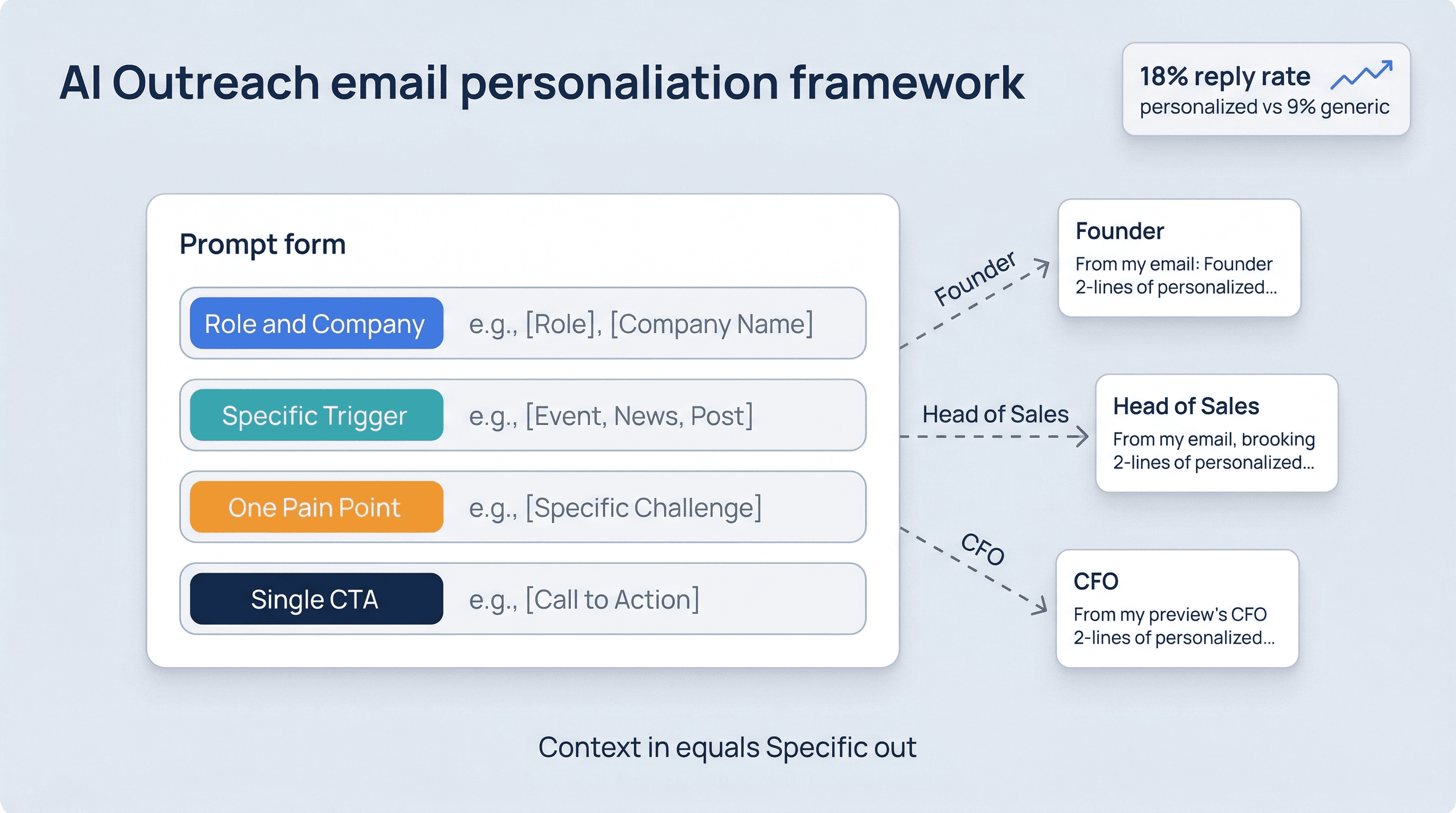
It means role-specific messaging that speaks to what each person actually cares about. The CFO needs a different message than the Head of Sales. The technical reviewer needs a different message than the champion. The same company, the same offer—but framed through each person's lens.
Practically, this means:
- Map the buying group before first contact, not after the deal gets stuck
- Build role-specific messaging for at least the top three roles
- Sequence outreach to different stakeholders with timing that makes sense—not all on the same day
- Use your champion's engagement as signal, but don't depend on them to introduce you
The best time to warm a CFO is before they're the bottleneck, not after the deal has been stuck for three months.
The pacing problem
Most teams don't fail at multi-threading because they don't know about it. They fail because it's time-intensive. Mapping every stakeholder across a 50-account target list, then running coordinated, role-differentiated outreach in parallel—that's a lot of work when you're also doing delivery and client calls.
This is where AI-driven account research changes things. Buying group mapping, stakeholder identification, and role-specific messaging at scale are all things that software can run across a target list continuously, without the manual bottleneck that limits most teams to one or two contacts per account.
The accounts you haven't touched
78% of accounts in active pipelines are single-threaded. That's not a stat about the companies with sophisticated multi-threading teams—that's the average, including them.
Which means there's a structural gap in most sales motions that no amount of cold email improvement closes. The fix isn't better copy. It's a different model of how you approach an account.
See buying committee coverage and account research for how to run this in practice. For comparisons, see AI SDR tools.