Cold Email Prompts That Actually Work: 20 Templates with Context
Not a list of copy-paste prompts. A framework for writing prompts that produce specific, relevant cold emails—with examples by angle and stage.
Most AI-generated cold emails are bad not because AI is bad at writing. They're bad because the prompt didn't tell the AI anything useful.
"Write a cold email for a sales tool targeting B2B companies" produces generic copy. Not because the model is incapable of better—because you gave it nothing to work with. The output will be vague because the input was vague.
Good cold email prompts are really just good briefs. The AI is the copywriter. You're the account director. If you brief a copywriter with "write an email that gets replies," you'll get an email that might get replies from someone, somewhere. If you brief them with specific context about who you're targeting, what their situation is, and what you want them to do, you'll get something specific.
Here's how to build that brief into a prompt.
The prompt structure that works
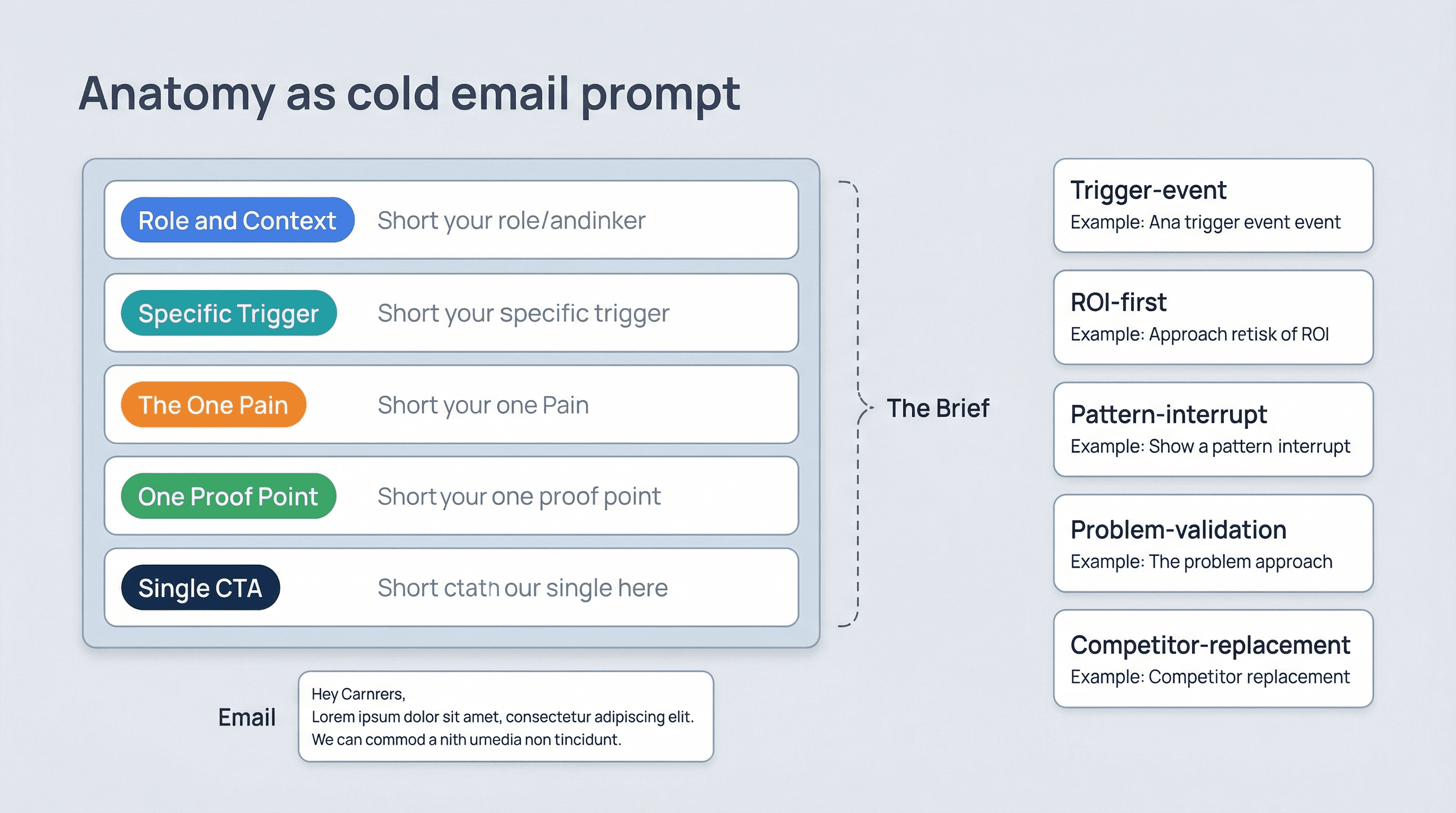
Every effective cold email prompt needs five things:
- Role and company type — Not just "a marketer." A VP of Marketing at a 50-person SaaS company that's scaling its outbound motion.
- Specific pain — The actual problem, not a generic category. "They're running outreach manually and losing follow-up threads" beats "they have sales challenges."
- Trigger or context — Why now? A recent funding round, a job posting for an SDR, a relevant industry event. This makes the email feel timely rather than random.
- Proof point — One specific, concrete result. "Cut their outreach time by 4 hours per week" beats "helps teams be more efficient."
- One CTA — Single. Specific. Low friction.
Prompts by angle
Trigger-event opener
Write a cold email to a Head of Growth at a B2B SaaS company.
They recently posted a job listing for an SDR role.
Context: we help companies replace early-stage SDR hires with automated outreach.
Pain: manual outreach at this stage delays pipeline and costs $80k+ before the hire ramps.
Proof: one example client got qualified meetings in week 2 without a full-time hire.
CTA: one question asking if they've looked at automated options before committing to hiring.
Keep it under 80 words. No fluff. No generic opener.
ROI-first opener
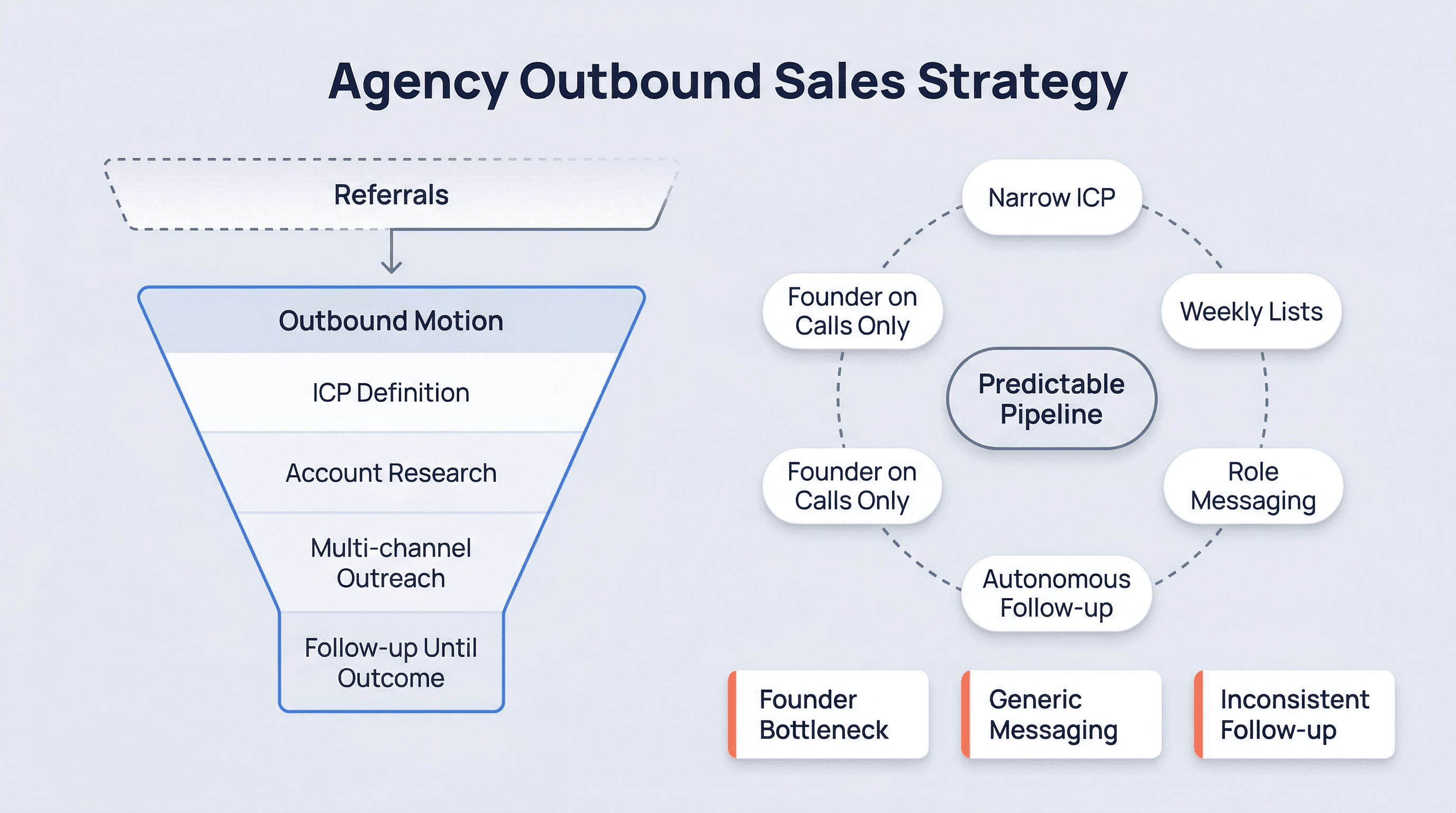
Write a cold email to a Founder of a 10-person marketing agency.
They're growing but rely on referrals for new clients.
Pain: inconsistent pipeline, no repeatable outreach motion.
Angle: lead with what they're leaving on the table by not having outbound.
Proof: a specific example—agency that added 3 qualified meetings per week without a new hire.
CTA: a reply confirming whether outbound is on their radar.
Under 75 words.
Pattern-interrupt opener
Write a cold email to a VP Sales at a 30-person B2B company.
Start with a counterintuitive observation about how most SDRs are misused.
Connect it to the waste of top-of-funnel volume being done manually.
Offer one insight, not a pitch.
CTA: ask if they'd want to see how this works in their pipeline setup.
Conversational tone, no marketing language, no bullet points.
Problem validation opener
Write an email that validates a problem before pitching.
Audience: Head of Sales at a consulting firm.
Start by acknowledging that multi-channel outreach is getting harder.
Reference one real stat about declining email reply rates.
Then offer one idea for what's working instead.
CTA: is this a problem worth a 10-minute conversation?
Under 90 words.
Competitor-replacement opener
Write a cold email for someone currently using [Competitor Tool].
Don't attack the competitor. Instead, note a specific limitation.
Connect it to a specific outcome our tool handles better.
Proof: one specific difference that matters to someone in that role.
CTA: a reply asking if that limitation is causing friction for them.
Non-aggressive tone. Factual, not snarky.
The editing prompt (as important as the writing prompt)
After you have a draft, run this:
Here is a cold email draft. Do the following:
1. Remove any sentence that could have been written without knowing who this is for.
2. Replace any vague claim with a specific one.
3. Cut any sentence that doesn't move the reader toward the CTA.
4. Check that the CTA is one action, clearly stated.
Output the revised version and note what you changed.
This editing prompt is often more valuable than the generation prompt. It forces the output toward specificity, which is what separates emails that get replies from emails that get archived.
What to give the AI before using any of these
The prompts above work better when you prepend context about your actual offer. Something like:
We build outbound automation for small agencies. Our product handles account research, multi-channel outreach, and follow-up. Typical result: 3–5 qualified meetings per week without a full-time SDR hire. Clients are typically agencies under 30 people or founders running outbound manually.
Then the role-specific prompt. The AI has enough context to write something that sounds like it came from a company with an actual position, not a template farm.
Use these prompts with account research to personalize at scale. For multi-channel execution, see multi-channel outreach. For reply handling after messages land, see reply handling.