Outbound Sales for Agencies: How to Build a Pipeline That Doesn't Depend on You
Most agencies grow on referrals until they can't. Here's the outbound model that creates predictable pipeline without the founder doing all the selling.
Most agencies don't build outbound because they don't need to. Referrals fill the pipeline until they don't, and by then the need is urgent rather than strategic.
The problem with building outbound from urgency is that urgency is a bad planning state. You need pipeline in 30 days but outbound takes 60–90 days to produce qualified meetings. The gap hurts.
The agencies that build predictable pipelines start outbound before it's necessary—and build it in a way that doesn't require the founder's personal relationships to work.
Why the referral ceiling feels sudden
The math of referral-led growth has a built-in fragility. You're selling to people your happy clients know. That network has a size. It depletes as deals close. The speed of new referrals depends on how often your clients mention you, how relevant those mentions are, and whether the people they mention you to have the right budget right now.
None of that is controllable.
The ceiling shows up not as a hard stop but as a slowdown. You still get referrals, but not enough to replace what's churning. You stop getting the types of clients you actually want. And you realize that the pipeline you have is mostly the legacy of relationships you built years ago.
At that point, outbound is the only lever left.
The model that works for most agencies
The core problem with agency outbound isn't that it doesn't work. It's that most agencies implement it wrong and conclude it doesn't work.
Wrong implementation looks like: the founder writes 10 cold emails in a slow week, sends them to names from a list someone bought, follows up once, and gets no replies. The conclusion is "cold outreach doesn't work for our type of business." The actual reason is that 10 emails to a random list is not a motion.
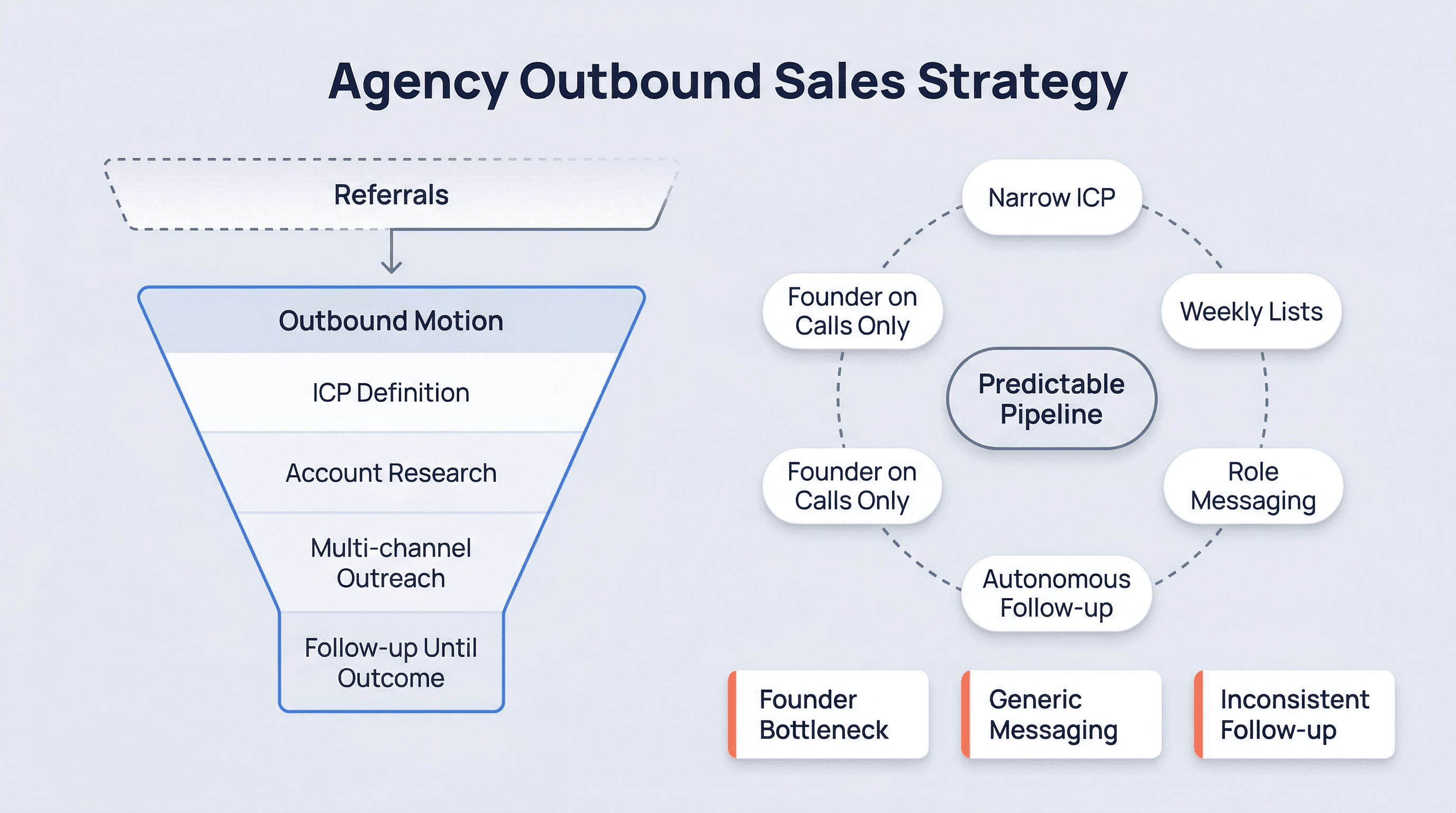
A motion looks like this:
1. Narrow ICP by deal size and decision-maker. "Marketing agencies for mid-market SaaS companies" is actionable. "B2B companies that could use our services" is not. The ICP determines who gets researched, what gets said to them, and which channel to use. Vague ICPs produce vague messages, which produce no replies.
2. Build account lists on a repeatable schedule. Weekly, the same way. New companies that match the profile, with the right decision-maker identified and verified. A list that sits untouched for two months is a list that goes stale.
3. Run research before outreach. The agencies getting 10–15% reply rates aren't sending better copy. They're sending messages that reference something real about the company—a recent hire, a funding announcement, a positioning gap that's visible from the outside. That research is what makes cold feel warm.
4. Execute multi-channel sequences. Email alone at 3–5% reply rates means you need to send to a lot of people to get a few conversations. Adding LinkedIn and WhatsApp (where appropriate) brings combined reply rates to 15–30% on well-targeted lists.
5. Follow up past two attempts. This one matters more than any other. 80% of deals need five or more touchpoints. Most sales reps stop after two. The fortune is genuinely in the follow-up—not metaphorically, specifically.
The founder bottleneck
The outbound motion that doesn't scale is the one where the founder writes every message, reviews every reply, and decides whether each conversation is worth a call.
That's not a pipeline. That's a second job.
Sustainable outbound separates the parts that require judgment (positioning, ICP definition, offer design, closing calls) from the parts that can be systematized (research, sequencing, follow-up, scheduling). The former stays with the founder. The latter doesn't.
When founders ask why their outbound isn't consistent, the answer is almost always that they're doing both when they should only be doing the first.
What changes when you separate execution from judgment
Once the execution layer runs without the founder's daily attention, the economics change. Outreach runs every week on schedule. Follow-up doesn't get missed when delivery spikes. New accounts enter the sequence as the pipeline needs them.
The founder's role becomes reviewing what's working, adjusting positioning, and taking calls. Not managing sequences, not chasing replies, not wondering if someone followed up on the warm lead from last week.
That's the version of outbound that agencies can actually sustain.
See marketing agencies and replace SDR. For tool comparisons, see AI SDR tools.